T:+86-135-8672-6294
No. 1118-2, Wushan South Road, Yandun Village, Qiaotou Town Ningbo Zhejiang China

Views: 0 Author: Site Editor Publish Time: 2026-07-29 Origin: Site
Tile-laying games demand precision, strategic thinking, and the right tactile environment. Many players overlook the foundational surface beneath their components. You might frequently find yourself playing directly on hard wood, glass, or plastic tables. This common baseline scenario creates intense friction. It also causes unwanted sliding and jarring acoustic challenges during aggressive shuffling. Over time, these harsh conditions degrade both your furniture and the game pieces.
Our objective is to provide a practical, evidence-based evaluation of tabletop surfaces. We will explore the functional role of game mats beyond mere aesthetics. You will learn why specialized play surfaces remain strictly necessary for serious gamers. We will guide you on how to assess different material options effectively before making a purchase. Understanding these dynamics changes how you play.
We will examine the exact mechanics of sound dampening, friction control, and component protection. By mastering these core principles, you can confidently upgrade your gaming setup. This knowledge ensures better durability and significantly improved player comfort.
Acoustic impact represents a major concern during tabletop sessions. Shuffling hard acrylic or melamine tiles on a bare table creates intense noise. Bare surfaces amplify sound waves directly into the room. We often measure this high-frequency clacking at uncomfortable decibel levels. A dampened surface absorbs these harsh vibrations efficiently. You experience a quieter, much more focused gaming session. Noise reduction prevents player fatigue over long hours.
Component and furniture protection is another critical mechanical factor. Heavy tiles feature sharp, rigid edges. Sliding these pieces across polished wood causes microscopic abrasions. Over continuous play, you will inevitably scratch glass or degrade lacquered wood finishes. The game components also suffer. Bare table friction wears down the painted markings on your pieces. A proper Mahjong Mat acts as a vital protective barrier for both items.
Tile manipulation and structural integrity rely heavily on surface tension. Bare tables cause stacked game walls to collapse easily. Smooth surfaces simply lack the necessary grip for vertical stacking. Conversely, a micro-textured surface provides optimal grip. This subtle texture holds stacked pieces securely. Simultaneously, it allows players to push rows smoothly across the board without snagging.
Finally, we must consider the ergonomics of tile retrieval. Picking up flat, heavy components from a completely flush hard table strains your fingertips. You often have to scrape your nails against the wood. A slightly compressible mat solves this issue entirely. It allows your fingers to press down slightly beneath the edge of the piece. This small compression makes lifting effortless and prevents finger strain.
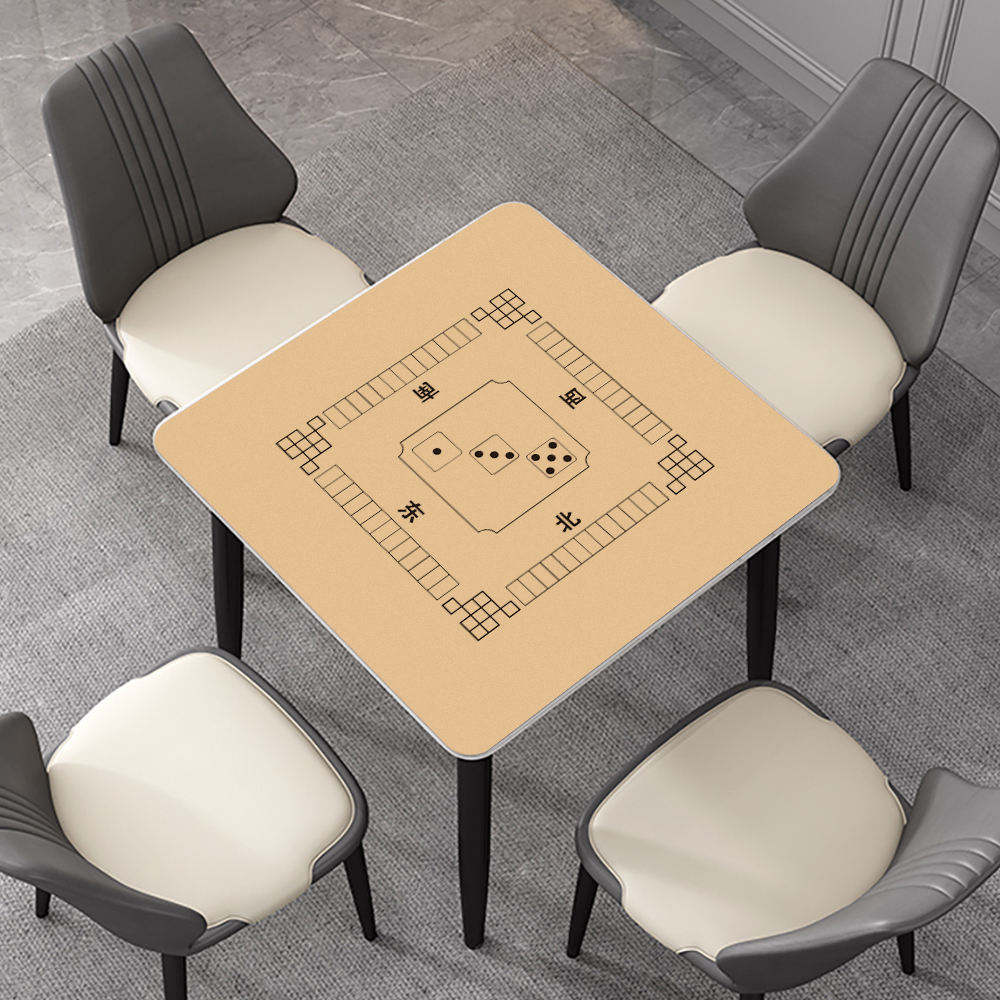
Material science dictates the performance of your play area. A Neoprene Rubber Mahjong Mat represents the modern standard for enthusiasts. It utilizes a highly functional dual-layer design. The top layer features a smooth woven fabric. This specific textile is engineered for effortless sliding. Beneath the fabric, a dense rubber base provides exceptional grip. This high-friction coefficient anchors the product firmly to the table. It prevents any shifting during aggressive shuffling.
Neoprene also provides inherent liquid resistance. If someone spills a drink, the liquid initially pools on top. It does not immediately soak through to the table. Furthermore, this material possesses excellent structural memory. You can roll it up tightly for transport. It will quickly lay completely flat upon unrolling. This memory eliminates frustrating wrinkles.
Traditional unsecured felt or wool presents a stark contrast. We acknowledge its classic aesthetic appeal. It also offers a low entry cost for beginners. However, felt exposes significant performance gaps quickly. Loose wool bunches up constantly during vigorous mixing. It lacks adequate grip on polished dining tables, sliding around haphazardly. Long-term use inevitably leads to surface pilling. These tiny fabric bumps disrupt smooth movement.
Our verdict on efficacy is clear. Neoprene objectively outperforms loose felt across all functional metrics. Serious players evaluating decision-stage options almost universally prefer modern rubber. It eliminates the physical frustrations associated with unsecured cloth fabrics.
When evaluating options, you must scrutinize specific physical criteria. Thickness and density directly influence acoustic dampening capabilities. We frame 2mm to 4mm as the strictly optimal range. Thinner materials fail to absorb sound adequately. You still hear loud table strikes. Conversely, thicker mats feel unpleasantly spongy. Heavy stacked tiles tend to tip over on overly plush surfaces.
Surface friction balance plays a pivotal role in playability. The top layer must offer low dynamic friction. This allows you to slide pieces freely. Simultaneously, it requires high static friction. High static friction ensures stacked walls remain perfectly in place. Balancing these two forces separates premium surfaces from generic ones.
Edge stitching guarantees long-term durability. You need anti-fray stitched edges immediately. Stitching prevents the top fabric from separating from the rubber base. Repeated friction from players' forearms will quickly destroy unstitched borders. Delamination ruins the aesthetic and functional value of the play area.
Dimensional accuracy maps directly to your furniture. Standard dimensions typically range from 31 by 31 inches to 33 by 33 inches. These specific measurements fit common folding card tables perfectly. They also adapt well to square dining tables. Accurate sizing ensures an adequate play area without any sloppy overhang.
Core Evaluation Parameters Table
| Evaluation Metric | Optimal Specification | Impact on Gameplay Performance |
|---|---|---|
| Thickness Range | 2mm to 4mm | Prevents sound echo; maintains vertical stacking stability. |
| Surface Friction | Smooth Top / Grippy Base | Allows easy shuffling while anchoring the surface to the table. |
| Border Finishing | Anti-fray Stitched Edges | Stops fabric delamination from repetitive forearm rubbing. |
| Dimensions | 31" x 31" to 33" x 33" | Provides maximum play area without overhanging the table edge. |
Broadening your investment makes logical sense. The structural benefits of a Non-Slip Mahjong Mat apply broadly to other heavy tabletop games. You are not just buying a single-purpose accessory. These surfaces elevate the entire gaming ecosystem in your home.
Consider games like Dominoes and Rummikub. The noise reduction mechanics map perfectly to these activities. Tile-picking ergonomics improve drastically across the board. You can scoop up flat dominoes smoothly. You no longer need to dig your fingernails into the wood to lift components. Play becomes physically easier.
Standard board games and trading card games (TCGs) also benefit immensely. The smooth surface facilitates lightning-fast card retrieval. You can pick up sleeved cards without bending their corners. Token management becomes less chaotic because pieces stay put. Furthermore, the liquid resistance protects expensive, heavy cardboard components from accidental table spills. Players routinely repurpose this setup for diverse weekly game nights.
Proper care dictates how long your equipment lasts. You must avoid common storage errors to protect your setup.
Following these maintenance protocols ensures reliable performance. Skipping these steps often results in premature wear and a compromised play surface.
Assess your primary play environment carefully. Match the dimensions strictly to the main table you use. Avoid buying items that drape over the table edges. Overhang severely compromises the non-slip tension. It causes the play area to pull, shift, and slide during intense moments.
Evaluate your frequency of play accurately. We guide casual players toward budget-friendly standard sizes. These offer adequate protection for occasional weekend games. However, we steer weekly enthusiasts toward heavy-duty models. Enthusiasts should prioritize edge-stitched neoprene. You need maximum durability to withstand rigorous, frequent shuffling sessions.
Follow a final pre-purchase checklist before buying. Verify exact dimensions against your actual furniture. Confirm the material composition includes a dense rubber base. Check for reinforced edge finishing in the product photos. Finally, note if the product includes useful storage accessories. Carrying bags or velcro straps make transportation much easier.
Purchasing a dedicated non-slip surface represents a major investment in your hobby. It extends game longevity, guarantees table protection, and maximizes player comfort. Upgrading your environment transforms a frustrating experience into a seamless, highly tactical one. Moving away from bare tables or loose felt is crucial. Transitioning to a structured rubber-backed mat is the single most impactful physical upgrade for tile-laying games.
A: We strongly advise against using a washing machine. Intense agitation and spin cycles risk severe delamination. This action separates the fabric from the rubber base. Instead, we recommend hand-washing or spot-cleaning. Use a soft cloth with mild dish soap to gently clean spills. Always let it air dry flat.
A: The standard 32x32 inch size generally accommodates both variants perfectly. This dimension provides ample central space for discarded tiles. It comfortably fits the tile walls, player hands, and standard racks used in American Mahjong. You gain unhindered movement without feeling cramped at the table.
A: If the edges curl after unboxing, reverse-roll the affected areas gently. Hold them for a minute. Alternatively, place it flat on your table. Apply flat, heavy weights to the curling corners. Leave these weights overnight for 24 hours. This trains the rubber memory to stay flat.
A: No, it does not replace the need for racks. Mats stabilize the walls and make picking up tiles easier. However, American Mahjong players still require traditional racks. You need them to organize your individual hands privately. Racks also provide pushers for extending the walls efficiently.